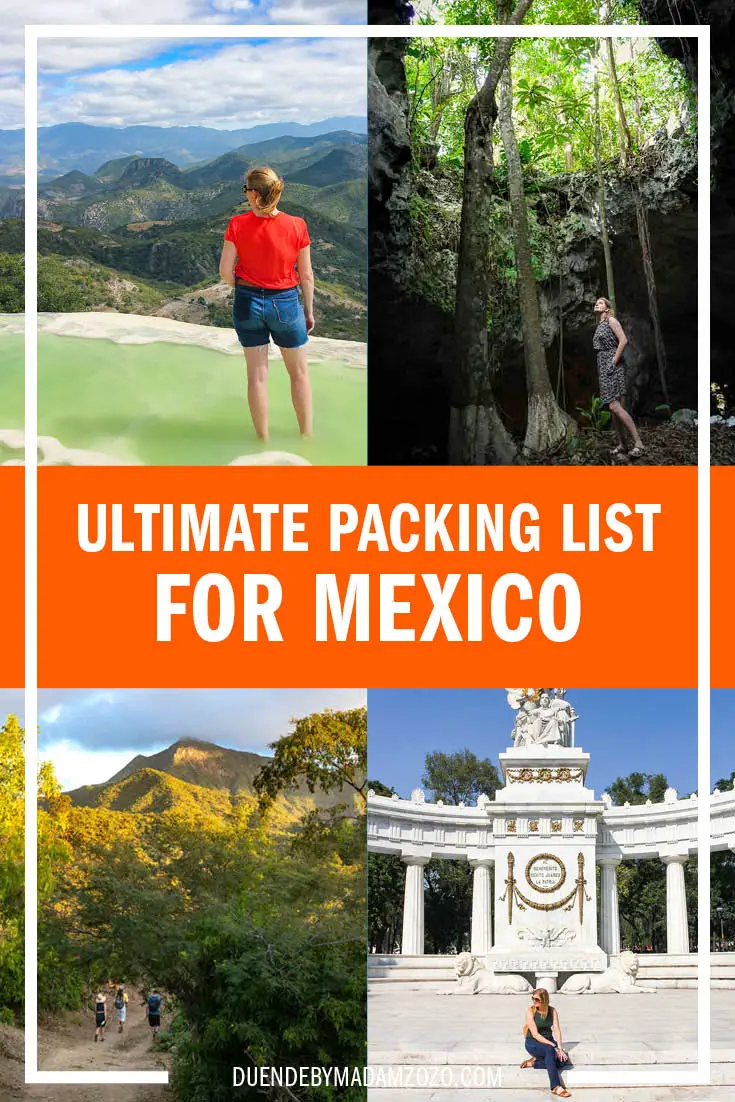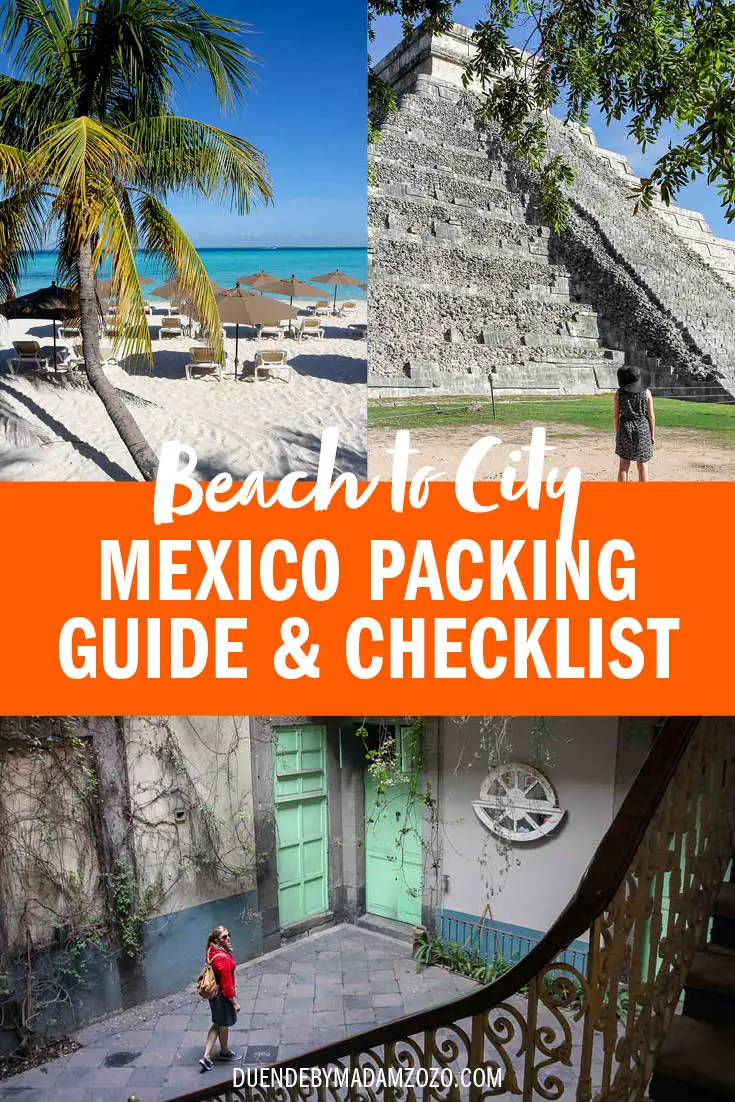
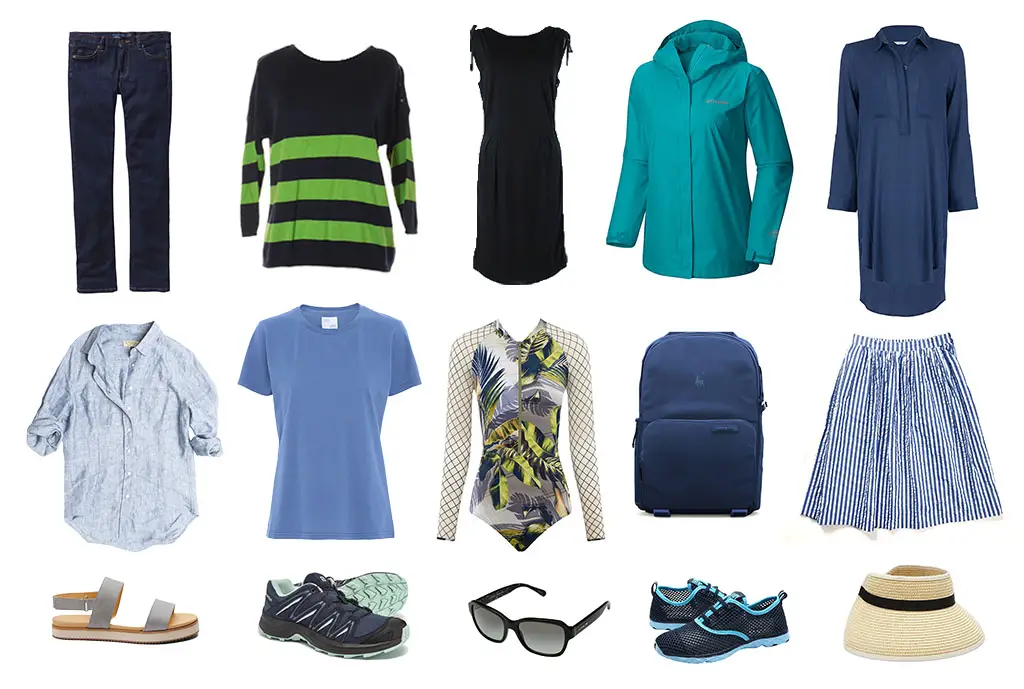
Mexico is a BIG, beautiful and diverse country. Destinations from mountain cities to coastal resorts experience a range of climate conditions and call for different styles of dress. From swimming in Yucatan cenotes and hiking Monarch butterfly-filled highlands to exploring sub-tropical cities–knowing what to pack for a trip to Mexico can feel overwhelmingly complicated. But it doesn’t have to be. just follow this guide and you’ll know exactly what to pack for Mexico.
In addition to this Mexico packing list, you may find these posts helpful in preparing for your Mexican adventure:
International Travel Checklist
Carry-on or Checked Baggage, How to Choose?

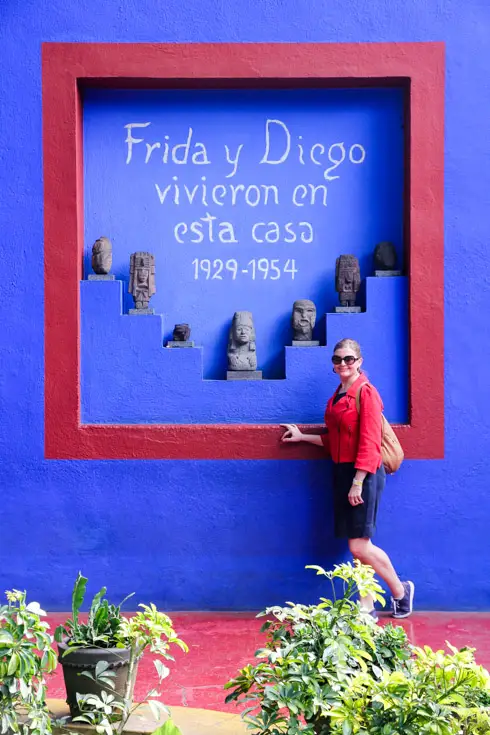
General notes on what to pack for Mexico
Climate
Mexico covers seven climate zones, ranging from temperate to arid, Mediterranean to tropical wet. So let’s look at the most popular destinations grouped in climate zones. If you are visiting destinations in more than one climate zone, you’ll likely need to pack more layers to accommodate the temperature variances.
Mexico City
Mexico City is located in a subtropical highland climate zone. From May through October is the wet season which is warm and often overcast with higher rainfall. May is generally the hottest month with average temperatures ranging from 13-26°C (55-79°F). November to April is the dry season with comfortable temperatures during the day, cool evenings and partly cloudy skies. January is the coldest month averaging 6-22°C (43-72°F). Average yearly rainfall totals around 722-mm (28.5-in).
San Miguel de Allende
San Miguel de Allende is situated in mid-latitude steppe and desert climate zones. Summers in San Miguel de Allende is warm April through June. May is the hottest month, with average temperatures ranging from 13-26C (56-84
F). Skies are cloudier from June through to October, aligning with a higher likelihood of rainfall. Annual precipitation amounts to about 570-mm (22.5-in) in San Miguel de Allende. November through February are cooler with partly cloudy to clear skies. Average temperatures in January, the coldest month, range from 5-22
C (42-72
F).
Cancún and Riviera Maya
Cancun and the coastline south of there, dubbed the Riviera Maya, are in a tropical savannah climate zone. This includes Playa Del Carmen, Tulum, Cozumel and other destinations on the Caribbean coast of the Yucatán Peninsula.
There are only slight climatic differences in this short strip of coastline. Generally, temperatures vary by a couple of degrees and rainfall increases the further south you travel. Also, hurricanes in the Atlantic Ocean can impact this part of the coastline with strong winds and heavy rains. Hurricane season is June to November.
Summers in Cancún and the Riviera Maya are hot and humid. June to September are the warmest months with temperatures peaking in July at 21-33°C (-°F). December to January to March are more comfortable, with the coolest temperatures in January ranging from 17-28°C (-°F).
May through October are cloudy and with about 30% chance of rain on any given day. Rain is usually in short, sharp deluges or storms. Tulum receives the least annual precipitation at about 1120-mm (44-in), while Cozumel is the rainiest, expecting 1490-mm (59-in) per year. March is the driest month across all locations and October receives the most rain.
Mazatlán
Mazatlán lies just a few miles south of the Tropic of Capricorn and in a transition zone between tropical savannah and dry, hot steppe. The hottest months are June through October with mostly overcast skies and regular rainfall. Temperatures climax in July with a range of 25-32°C (°F). December to March are cooler, dipping to a range of 13-26°C (55-79°F) in January. Annual rainfall amounts to 722-mm (28.5-in).
Acapulco, Puerto Vallarta, Puerto Escondido and the Pacific Coast
Like its Caribbean coast cousin, the lower Pacific Coast of Mexico including Acapulco and Puerto Escondido, is classed as tropical savannah. January is unanimously the coolest month with temperatures ranging from 17-34°C (°F). The warmest month varies from May in Puerto Escondido to July in Puerto Vallarta with averages in the realm of 25-34°C (°F).
Rainfall increases the further south you go. Acapulco receives approximately 1285-mm (50.5-in) on average; Puerto Vallarta 1497-mm (59-in); and Puerto Escondido 2062-mm (81-in).


Cabo San Lucas and Baja California Sur
Cabo San Lucas and the state of Baja Peninsula Sur are located in tropical and sub-tropical desert zones. May to October are the hottest months. August is the hottest at 25-36°C (°F). December to March are more temperate. January experiences the lowest temperatures ranging from 25-34°C (°F).
Cabo San Lucas receives around 290-mm (11.5-in) of rain each year, while further north in the State’s capital of La Paz, 170-mm (6.5-in) are expected per year. April-May are the driest part of the year and August-September see the most rain.
Oaxaca and Puebla
Oaxaca and Puebla are both classified as subtropical highland climates. They are generally warm to hot during the day and cooler at night. While Puebla is the slightly cooler and the more rainy of the two.
Oaxaca is warmest March to May, May being the hottest with average temperatures ranging from 13-31°C (72-89°F). June to January are cooler with temperatures bottoming out in January when temperatures range between 8-28°C (63-83°F). Annual precipitation in Oaxaca totals about 655-mm (25.8-in) and wet season is considered Mary to October.
Poblano summers run March to June. May is the warmest month with average temperatures ranging from 12-26°C (54-79°F). Winters are December to February, with January being the coolest month. January averages between 6-21°C (43-70°F). May to October is the wettest time of the year and Puebla receives approximately 955-mm (37.6-in) average precipitation.
Guadalajara
Guadalajara is located in a humid subtropical climate zone. April to June are the warmest months peaking in May with temperatures ranging from 14-31°C (57-88°F). November to February are cooler, with January the coolest month, averagings temperatures of 5-24°C (41-75°F). Mid-May to mid-October is overcast and have a greater chance of rain. Annual rainfall in Guadalajara totals around 860-mm (34-in).
Monterrey
Monterrey is categorized as a mid-latitude steppe and desert climate zones. Summers run May through to September and are the wetter months. August is the hottest and cloudiest month of the year, with average temperatures ranging from 23-34C (73-94
F). Skies are clearest April to July. November through February are cooler with partly cloudy to clear skies. Average temperatures in January, the coldest month, range from 10-22
C (50-71
F). Annual precipitation in Monterrey averages around 590-mm (23.2-in).
Consult a reputable weather forecast before packing for your trip. This might also include looking at water temperatures if you plan on doing a lot of water-based activities.


Currency
The Mexican Peso (MXN) is the currency used in Mexico. It comes in banknote denominations of 20, 50, 100, 200, 500, 1000.
Credit cards are readily accepted, particularly in hotels and frequently touristed restuarants and shops. Having some cash is recommended for smaller businesses, tipping and emergencies. Generally, you’ll get the most favourable exchange rates by withdrawing Pesos at ATMs, rather than using money exchanges (“cambio” in Spanish).
Important note: Beware of skimming scams at ATMs and points of sale where you swipe your card, such as at gas pumps.
Electronics
Electricity in Mexico is delivered at 127-V and 60-Hz, using type A and B sockets. This means devices from the US will not need an adaptor. However, if you are from other parts of the world, you may need an adaptor and possibly a convertor.
Generally, modern phones, tablets and laptops are made for both 110V and 220-240V, but it pays to check this detail. Look at the label on your device, if it reads “INPUT: 100-240V, 50/60 Hz” you are safe to use it in Mexico.
Environment
Consider the environment when you are planning what to pack for Mexico. Some destinations have limited capacity for garbage disposal and/or recycling. Try to minimize single-use products, especially plastics – these guides will help: 8 Essential Eco-Friendly Travel Products and 5 Steps to More Sustainable Travel.

Etiquette
Generally, the warm climate of Mexico means people tend to dress more casually. In cities and urban environments people tend to dress in a smart-casual style, while beach towns and rural villages are more relaxed. For special evenings out at fancy restaurants or cultural performances, dress appropriately, and avoid jeans.
Fabrics
Warm to hot weather calls for lightweight, breathable fabrics. The best materials to wear in tropical and dessert climates are cotton, linen, hemp and maybe some silk. Rayon fabrics like Modal, Viscose or Tencel are also somewhat breathable. Synthetics such as polyester and nylon will make you sweat and should only be worn as rain gear, swimwear or other specialist outdoor clothing.
Health
There are various health risks you should be aware of in Mexico, including vaccine preventable diseases; mosquito transferred diseases such as Zika and Dengue; along with food-borne illnesses. See the CDC Mexico Travel page for up-to-date risk and prevention information.
Ensure you pack an insect repellent that contains recommended amounts of DEET, picaridin or other scientifically proven product e.g. RID Tropical Strength or OFF Deep Woods. Cover up at sunrise and sunset when mosquitoes are most active.
Sunscreen is another absolute essential. Ensure it has a minimum SPF of 30+ and is water resistant for swimming.
Lastly, a basic medical and first aid kit is ideal for Mexico. I recommend booking a visit with a specialist travel doctor to ensure you have the right vaccinations and who can provide a prescription for items that are not available over-the-counter. See the CDC’s checklist of medical supplies to take when you travel here.
Luggage
Depending on where you travel in Mexico, you may be presented with dirt roads, sand, stairs and cobblestone streets. Therefore, roller bags are not ideal and a backpack or duffel are a better option.
A smaller, foldable backpack or beach-bag style tote is a good day-bag options depending on your activities. Adventure travellers should also consider a drybag for water-based excursions.
Security
Whenever you are travelling it is best to leave any unnecessary jewellery and valuables at home. Some travellers like myself, only pack and wear costume jewellery for overseas trips.
Consider taking a money belt or other secure pocket to carry cash, passport etc while sightseeing. See more general safety and security tips here.

What to pack for Mexico
Let’s jump into some specifics about what to pack for a trip to Mexico. You can download a printable checklist at the end of this post.
Travel documents
Passport – International travellers, ensure your passport has at least 6 months validity and plenty of blank pages for your new passport stamps.
COVID-19 vaccination card
Visa – Check if you need a visa for entry. This will depend on which country issued your passport and the length of your stay.
Itinerary, reservations and tickets – It is best to pack a paper copy of these items just in case internet is not available or your device battery goes flat. You can also opt to download a copy to your phone so you aren’t reliant on internet connection.
Travel insurance – Pack a copy of your travel insurance policy and emergency contact details for your insurer. I also program the international dialling number in my phone so it is ready to go if something bad were to happen.
Basics
Underwear, bras and socks – Cotton underwear and socks are preferable for breathability and coolness in tropical vacation destinations.
Sleepwear – Again cotton or other natural fabrics are best for keeping you cool during the night. A sleep mask and ear plugs may also be ideal for light sleepers.
Shirts – If this is a strictly beach/pool trip and you will spend most of your days in swimwear, or if it is winter in one of Mexico’s more temperate destinations—1 shirt for every 2 days might be enough. Alternatively, if you are going to be doing active, adventure activities and/or it is summer, pack one shirt per day.
Shorts –1 pair for every 2 days. I recommend shorts that will be cool, provide sun protection, and are comfortable for light walking (without chaffing). Note: locals, particularly in bigger cities, tend to be more European in their style of dress. Shorts aren’t common especially for women. A skirt or lightweight long pants will help you blend in.
Full-length pieces – 1-2 pairs of lightweight pants/ maxi skirt/ jumpsuit/ maxi dress to wear in the evening when it’s a little cooler, mosquitos are biting or when you’re in an air-conditioned space.
Light jumper (sweater) – Mostly for the cooler months and air-conditioned spaces.
Shoes – A pair of sturdy shoes for light hiking and sightseeing; water shoes for snorkelling excursions and swimming in cenotes and other natural pools. Pack some nice sandals or boots for evenings depending on the season. Remember that many of Mexico’s colonial cities have cobblestones and other uneven surfaces. Heels are not recommended.
Swimsuit and/or boardshorts– Choose a swimsuit appropriate for your activities. A string bikini may work for lounging by the pool but it’s not ideal for kayaking, surfing or any kind of adventure. Also, in the tropical humidity everything takes a longer time to dry out, so if you prefer to put on a dry suit in the morning pack two and alternate.
Rashguard – Good for added sun protection during long stints in and on the water.
Coverup – A sarong or other coverup to keep you sun protected and modest between swims. Maybe even a cute poolside co-ord in light, quick-drying fabric.
Toiletries
Deodorant
Toothpaste and toothbrush
Shampoo and conditioner
Aloe Vera – Aloe vera gel is great to have on hand if you get sunburned. It can also be used as a general moisturizer.
Face wash/make-up remover
Body wash
Moisturizer
Hair accessories (ties and pins)
Menstrual products
Razor and shaving cream
Light makeup and perfume – See my post on travel makeup for how to pack your cosmetics and which products to look for.
Laundry soap – I pack a cake of laundry soap, so I can wash underwear and socks in the hotel bath or basin if need be.
Gadgets
International adaptor, ideally with a USB socket
Voltage convertor, if necessary
A camera and accessories including charger, spare batteries; SD cards; and tripod. Polarizing and neutral density filters for your DSLR would also be helpful for the harsh tropical light.
A waterproof camera (or waterproof case for your phone) is a must for water activities.
Phone and charger.
Portable power bank.
Headphones.
Day bag/ beach bag
Refillable water bottle
Hand sanitizer and mask
Bandana/cloth napkin/handkerchief
Toilet paper in a ziplock bag to keep it dry
First aid kit
Medications and prescriptions
Dry bag for keeping your camera, phone and other water sensitive valuables dry, during water activities.
Secure wallet, money belt or bra pouch
Medications and prescriptions
Reading glasses
Sunscreen with SPR 15+ or higher
Lip balm with SPF 15+ or higher
Insect repellent
Hat – A wide brim, well fitting hat that won’t blow off easily.
Sunglasses – Choose eye protection that is UV-rated and polarized to cut glare from reflective surfaces such as water.
Rain jacket or poncho, especially for wet season.
Guidebook
Flashlight or headlamp
Making memories and filling spare time
Book
Sketch pad and pencils/paint
Tablet device
Diary or notebook
Playing cards or travel games
I hope this guide helps ease the stress of working out what to pack for your trip to Mexico. If you have any feedback or items to add, please let me know in the comments below.
Peace, love and inspiring travel,
Madam ZoZo